Falcon Heavy
The world's most powerful operational heavy-lift rocket with synchronized side booster landings.
Falcon Heavy is a heavy-lift launch vehicle designed and manufactured by SpaceX. Composed of three Falcon 9 nine-engine cores strapped together, its 27 Merlin 1D engines generate over 5 million pounds of thrust at liftoff. Falcon Heavy provides unprecedented payload capability to high-energy geostationary, lunar, and interplanetary trajectories while retaining dual-booster propulsive landing recovery.
SpaceStats Reliability & Flight Record

Architecture Analysis & Development Story
Engineering DossierHistory & Development
Initially announced in 2011, developing Falcon Heavy proved significantly more complex than simply strapping three Falcon 9 boosters together due to intense structural loads on the reinforced center core. The vehicle made its historic test flight on February 6, 2018, launching Elon Musk's Tesla Roadster on a heliocentric trans-Mars orbit accompanied by synchronized simultaneous side-booster landings at Landing Zones 1 and 2.
Operational Record & Mission Impact
Falcon Heavy holds a 100% mission success record, executing high-profile missions including NASA's Europa Clipper flagship mission to Jupiter's icy moon, the Psyche asteroid explorer, US Space Force classified payloads to direct GEO, and NOAA GOES-U weather satellites.
Key Engineering Innovations & Design Highlights
27 Merlin 1D engines firing in parallel at liftoff producing over 22.8 MN (5.1 million lbf) of sea-level thrust.
Reinforced center core designed to withstand extreme aerodynamic shear and structural compressive loads.
Dual synchronized side booster return-to-launch-site (RTLS) propulsive recoveries.
High-energy direct-injection capability for National Security Space Launch (NSSL) and outer solar system flagship probes.
Technical & Propulsion Specifications
Operator: SpaceXVehicle Dimensions & Mass
- Overall Height
- 70 m
- Body Diameter
- 12.2 m
- Gross Lift-off Mass
- 1,420.8 t
- Stages Count
- 2
- Fairing Diameter
- 5.2 m
- Strap-On Boosters
- 2x Boosters
First Stage Core + Dual Side Boosters
- Main Engines
- 27x Merlin 1D (3x Octaweb)
- Propellant
- Densified LOX / RP-1
- SL Thrust
- 22,819 kN
- Vacuum Isp
- 311s
- Dry Mass
- 65 t
- Recovery Mode
- RTLS
Upper Stage
- Upper Engine
- 1x Merlin 1D Vacuum (MVacD)
- LEO Capacity
- 63.8 t
- GTO Capacity
- 26.7 t
- TLI (Lunar)
- 15.3 t
- Cost per Launch
- $97,000,000
- LEO Price / kg
- ~$1,520 / kg
Launch Complexes & Spaceports Network
1 Active Launch PadsMilestone & Historic Missions
Key Flight AchievementsFalcon Heavy Test Flight
Customer: SpaceX
Inaugural demonstration flight carrying Elon Musk's cherry red Tesla Roadster and Starman to heliocentric orbit.
Europa Clipper
Customer: NASA Jet Propulsion Laboratory
Flagship planetary science mission launched on an interplanetary direct-escape trajectory to Jupiter.
High-Resolution Photo Gallery & Media
4 photos & renders of Falcon Heavy with verified copyright credits
Falcon Heavy Clearing Launch Tower 39A
Falcon Heavy lifting off from Kennedy Space Center Launch Complex 39A clearing the Fixed Service Structure.

Synchronized Dual Side Booster Landing
Falcon Heavy twin side boosters touch down simultaneously at Landing Zones 1 and 2 in Cape Canaveral.
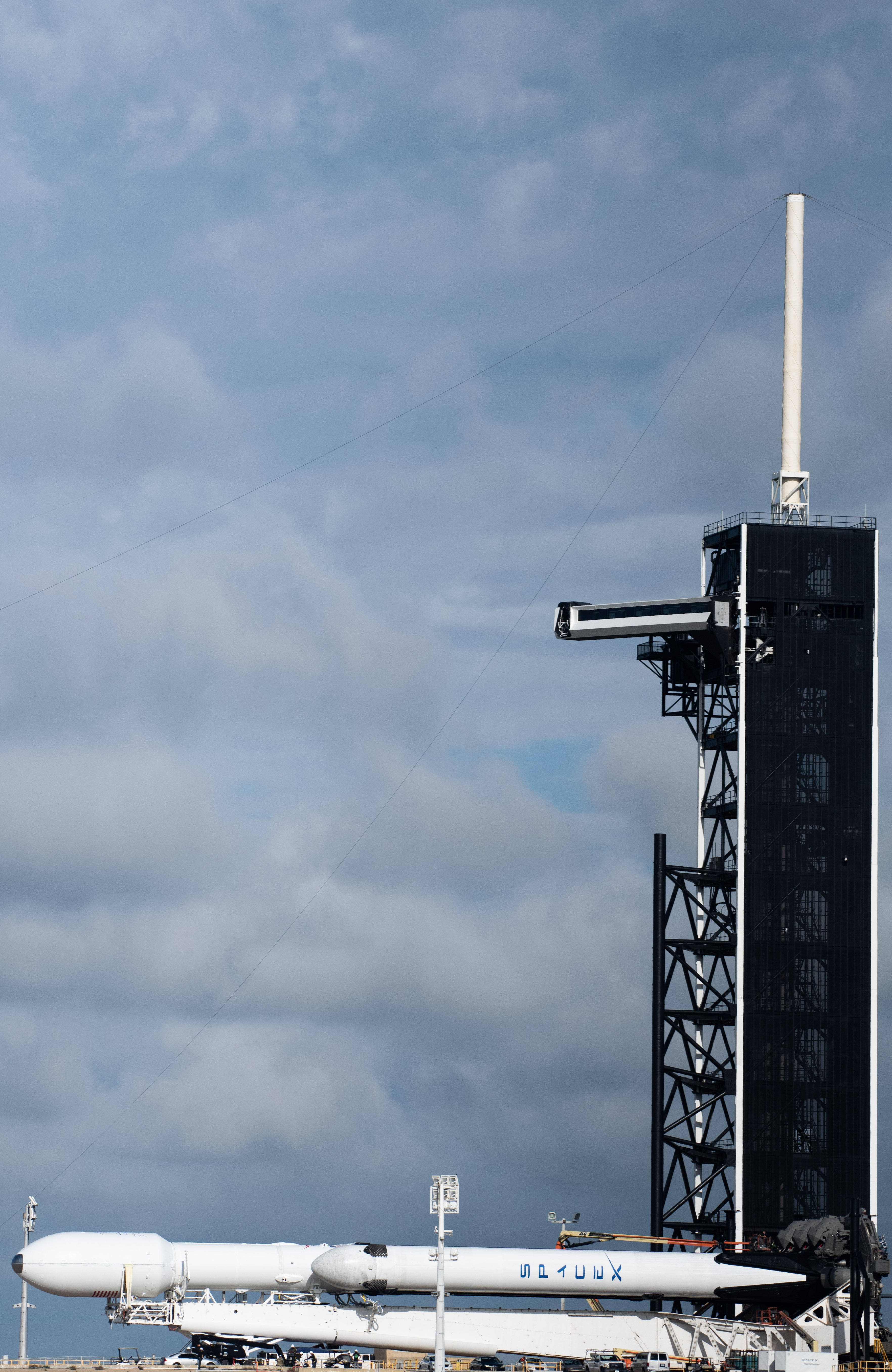
Falcon Heavy on Launch Complex 39A
Triple-core Falcon Heavy vehicle standing tall on historic Pad 39A prior to static fire testing.

Falcon Heavy Psyche Mission Booster Recovery
Booster descent burn following the successful launch of NASA's Psyche deep space asteroid probe.
SpaceStats Launch Manifest & Database
1 mission records cataloged in database
| Flight / Mission | Orbit | Launch Date | Pad / Location | Booster / Landing | Status | Details |
|---|---|---|---|---|---|---|
Falcon Heavy | Nancy Grace Roman Space Telescope Nancy Grace Roman Space Telescope | L2 | Aug 30, 2026 | Launch Complex 39A Kennedy Space Center, FL, USA | Unknown FH ASDS | GO | Details → |