Space Launch System
NASA's deep space super heavy-lift rocket built for human exploration of the Moon and deep space.
The Space Launch System (SLS) is an American super heavy-lift expendable launch vehicle developed by NASA for human exploration of the Moon under the Artemis program. Utilizing four RS-25 cryogenic engines and two 5-segment solid rocket boosters, SLS is designed to launch the Orion spacecraft, human crews, and heavy cargo on Trans-Lunar Injection (TLI) trajectories directly to lunar orbit.
SpaceStats Reliability & Flight Record
Architecture Analysis & Development Story
Engineering DossierHistory & Development
Authorized by Congress under the NASA Authorization Act of 2010, SLS builds upon flight-proven Space Shuttle propulsion technology while extending scale to 5-segment solid boosters and a 8.4-meter diameter cryogenic core stage. On November 16, 2022, SLS Block 1 made its flawless maiden voyage on the Artemis I mission, sending an uncrewed Orion spacecraft into a Distant Retrograde Orbit around the Moon.
Operational Record & Mission Impact
Successfully launched Artemis I on a 25.5-day mission testing deep space communications, navigation, and extreme 40,000 km/h lunar re-entry heat shield performance.
Key Engineering Innovations & Design Highlights
Core Stage with four RS-25 (Space Shuttle Main Engines) burning Liquid Hydrogen and Liquid Oxygen at an extreme specific impulse of 452 seconds.
Two 5-segment solid rocket boosters generating 32 MN (7.2 million lbf) of thrust at liftoff—the largest solid rocket boosters ever flown.
Interim Cryogenic Propulsion Stage (ICPS) powered by an RL10B-2 engine executing the Trans-Lunar Injection (TLI) burn.
Human-rated launch vehicle design with advanced flight computers and Launch Abort System (LAS) integration.
Technical & Propulsion Specifications
Operator: NASAVehicle Dimensions & Mass
- Overall Height
- 98.2 m
- Body Diameter
- 8.4 m
- Gross Lift-off Mass
- 2,600 t
- Stages Count
- 2
- Fairing Diameter
- 8.4 m
- Strap-On Boosters
- 2x Boosters
Core Stage + Dual 5-Segment SRBs
- Main Engines
- 4x RS-25 (SSME)
- Propellant
- Liquid Oxygen (LOX) / Liquid Hydrogen (LH2)
- SL Thrust
- 7,440 kN
- Vacuum Isp
- 452s
- Dry Mass
- 85 t
- Recovery Mode
- None
Interim Cryogenic Propulsion Stage (ICPS)
- Upper Engine
- 1x RL10B-2
- LEO Capacity
- 95 t
- TLI (Lunar)
- 27 t
- Cost per Launch
- $2,000,000,000
- LEO Price / kg
- ~$21,052 / kg
Launch Complexes & Spaceports Network
1 Active Launch PadsMilestone & Historic Missions
Key Flight AchievementsArtemis I
Customer: NASA
Inaugural flight of the SLS rocket, inserting Orion on a flawless translunar trajectory.
High-Resolution Photo Gallery & Media
2 photos & renders of Space Launch System with verified copyright credits
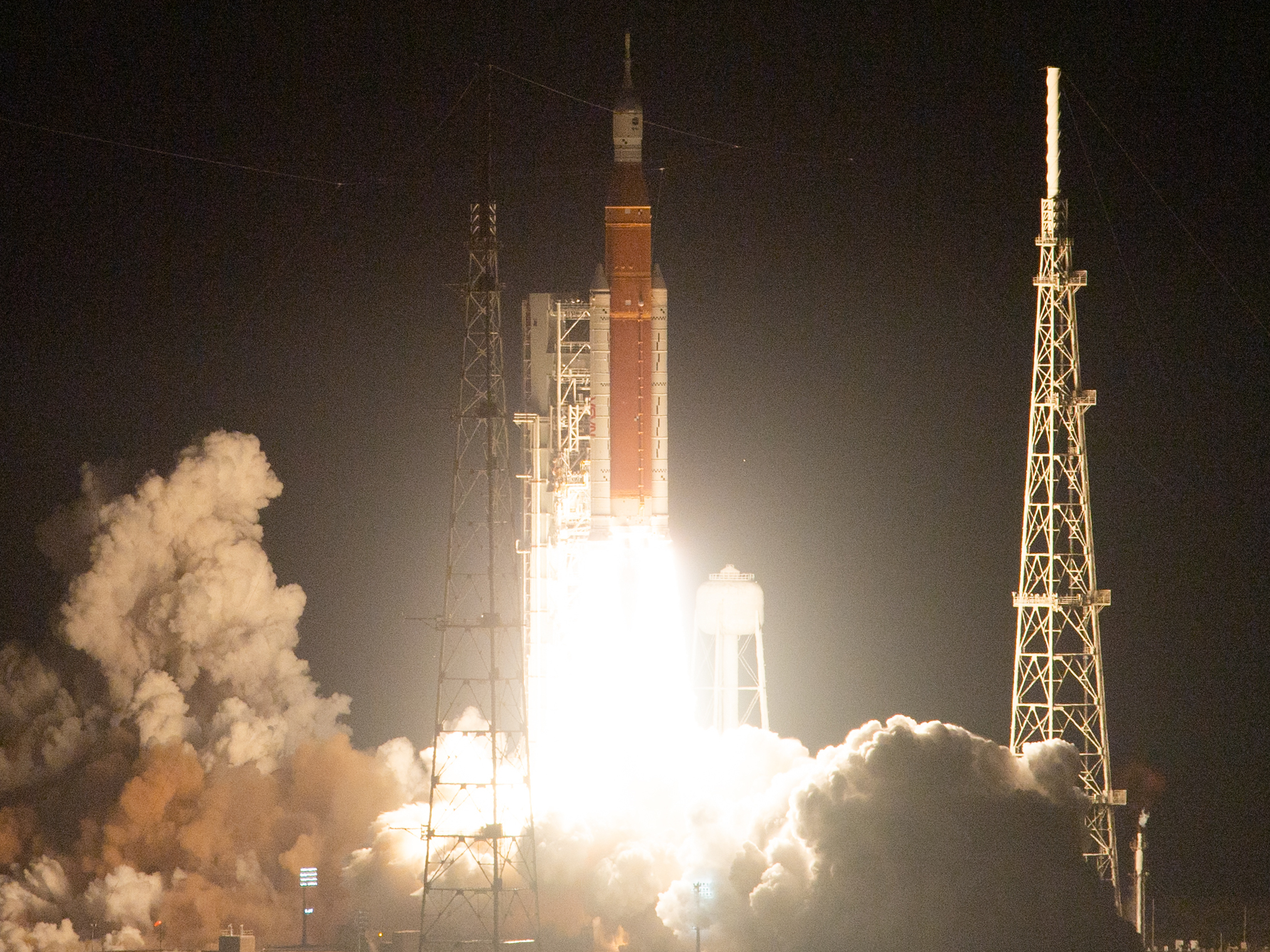
Space Launch System Artemis I Night Liftoff
NASA Space Launch System (SLS) lifts off from Launch Complex 39B carrying the uncrewed Orion spacecraft to the Moon.

SLS Twin Solid Rocket Boosters Ignition
Twin 5-segment solid rocket boosters and 4 RS-25 core engines deliver 8.8 million pounds of thrust at liftoff.
SpaceStats Launch Manifest & Database
0 mission records cataloged in database
No individual manifest entries logged in database for Space Launch System.
Summary stats and flight achievements are detailed in the overview above.